

By Bernard Walsh, Head of Investments & Pensions at Fairstone Ireland
Key Takeaways:
- ESG investing integrates environmental, social, and governance factors into financial decision-making alongside traditional metrics.
- ESG is now central to risk management, regulatory compliance, and long-term value creation in finance and investing.
- For financial advisers, applying ESG principles effectively requires more than headline awareness; it calls for robust data analysis, an understanding of relevant frameworks, and informed professional judgement.
- ESG strategies vary widely, from exclusions and ESG funds to impact investing and active ownership.
- A deeper understanding of ESG, supported by structured education, helps reduce the risk and impact of greenwashing and supports more confident decision-making.
Why ESG Feels Confusing — and Why That Matters
If you’re working with ESG today - whether in finance, investment, or through CPD - you’ll recognise a familiar tension: ESG is widely discussed, but not always clearly understood.
At a high level, ESG is presented as both a moral imperative and a financial opportunity. But when you look closer, the reality is more complex. Frameworks differ. Data is inconsistent. Terminology is used loosely. And expectations from clients, regulators, and employers continue to rise.
For many professionals and learners, three core pain points tend to surface:
-
Understanding ESG beyond the headlines
Knowing what ESG stands for is one thing; interpreting ESG data, ratings, and disclosures in a meaningful way is another. Bridging that gap requires moving from definitions to practical application.
-
Applying ESG confidently in financial and investment decisions
Translating ESG investments concepts into portfolio construction, fund selection, or client conversations is not always straightforward. It requires clear frameworks and, often, experience with real-world cases.
-
Keeping pace with evolving standards and expectations
ESG is not static. Regulation, reporting standards, and market practices continue to evolve. Staying current is essential for maintaining credibility.
The landscape is changing quickly, making it essential to upskill to keep pace. New reporting requirements are reshaping what companies disclose and how investors use that information. Political forces are impacting the ESG agenda more than ever. The combination of technical change, regulatory flux and political noise can make it harder to maintain the place of ESG at the core of investment decision making.
Underneath all of this sits a more fundamental question. ESG is ultimately about how organisations make decisions: how they balance profit with environmental and social considerations, how they exercise judgement where rules are not explicit, and how they build trust over time. Seen this way, ESG becomes less about box-ticking and more about better decision-making.
This guide is designed to bring some structure to that complexity - explaining what is ESG investing, how it works in practice, and where it is heading.
What Is ESG Investing?
Environmental, Social, and Governance (ESG) criteria are a set of standards used to assess how a company operates beyond traditional financial statements.
At its core, ESG investing integrates non-financial factors into investment decisions to better understand long-term risk, opportunity, and impact.
- Environmental: How a company interacts with the natural world.
- Social: How it manages relationships with employees, customers, and communities.
- Governance: How it is directed, controlled, and held accountable.
The underlying idea is that financial performance and sustainability are interconnected. Issues such as climate risk, labour practices, and governance standards can materially affect long-term value.
The Importance and Rise of ESG Investing
Several forces have moved ESG from a niche concept into the mainstream:
- Investor demand has increased as awareness of climate risk and social responsibility grows
- Regulators are placing greater emphasis on transparency and disclosure
- Asset managers are increasingly looking for opportunities to integrate ESG into conventional strategies.
- ESG is now relevant across all asset classes, not just equities.
Together, these forces have moved ESG from a niche concept to a mainstream investment consideration.
In Europe, this shift is reinforced by frameworks such as SFDR and CSRD, which aim to improve the consistency and availability of sustainability information. At the same time, scrutiny of ESG claims is increasing, raising the cost of compliance.
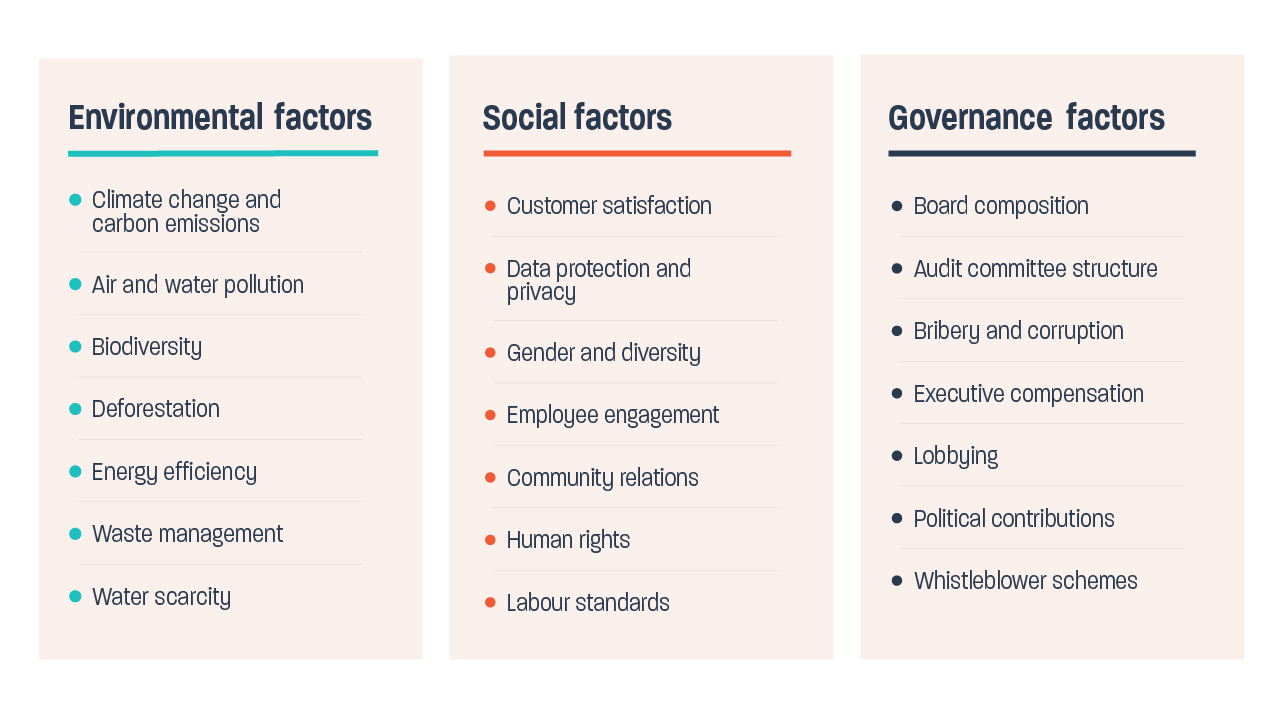
ESG Investing Criteria Explained
Environmental Factors
Environmental analysis looks at how companies manage their impact on the planet, including:
- Carbon emissions and climate exposure
- Energy use and efficiency
- Pollution, waste, and water management
- Biodiversity and resource use
These factors can directly affect costs, regulation, and long-term viability.
Social Factors
Social considerations focus on how companies manage relationships with stakeholders:
- Working conditions and labour standards
- Diversity and inclusion
- Health and safety
- Data privacy and customer trust
- Community and human rights
Weaknesses in these areas can lead to reputational damage, disruption, and legal risk.
Governance Factors
Governance examines how companies are directed and controlled:
- Board structure and independence
- Executive pay and incentives
- Risk oversight and audit
- Transparency and reporting
- Anti-corruption measures
Strong governance supports accountability and long-term thinking.
It is also where culture becomes visible. The quality of decision-making, the willingness to challenge, and the ability to look beyond short-term pressures are difficult to measure—but tend to show up over time.
ESG Investing, Ratings and Strategies
ESG Ratings
Common challenges include:
- Inconsistent data
- Different weightings of factors
- Limited transparency
As CSRD and similar frameworks improve disclosure, data quality should improve, but ratings will always involve judgement. They are a starting point, not a definitive answer.
Investment: ESG Funds, ETFs, and Portfolios
Investors can access ESG exposure through:
- ESG-focused mutual funds and ETFs
- Actively managed sustainable portfolios
Selecting quality ESG investments requires:
- Clear fund objectives
- Transparent processes
- Evidence of active stewardship, not just marketing claims
Strategies for Integrating ESG Into Portfolios
In practice, ESG investing can take several different approaches — and the one used will shape what ends up in a portfolio and why.
|
Approach |
Core Action |
What it looks like in practice: |
|
Negative Screening |
Exclude |
Avoiding specific sectors, activities, or issues that do not meet defined ESG criteria. |
|
Positive Screening |
Select |
Favouring companies with stronger ESG performance relative to peers, based on defined metrics or ratings. |
|
Impact investing |
Target outcomes |
Investing with the intention to deliver measurable environmental and/or social outcomes alongside a financial return. |
|
Active ownership |
Engage |
Using engagement and voting to encourage companies to improve ESG practices over time. |
Most portfolios use a combination. The key is aligning the approach with the client’s objectives and being realistic about outcomes.
ESG Investing: Myths vs Reality
ESG often sits at the intersection of values, regulation, and performance, which makes it prone to simplification.
In reality, it is a broad set of approaches with different objectives and trade-offs.
|
Myth |
Reality |
|
ESG investing sacrifices returns |
Research suggests that ESG integration can support long-term, risk‑adjusted performance, though outcomes will vary. |
|
All ESG funds are the same |
ESG approaches differ widely. Understanding the underlying strategy is essential. |
|
ESG is only about ethics |
ESG is increasingly focused on financial materiality, resilience, and long‑term value creation, not just values or ethical preferences. |
A further misconception is that compliance equals quality. Meeting minimum standards matters, but effective ESG goes beyond that - focusing on whether a business is genuinely sustainable, not just compliant.
It is also worth recognising the political dimension. In some markets, particularly parts of the US, ESG has become part of broader debates. For practitioners, the focus needs to remain on underlying economics and governance rather than headlines.
Future Trends of ESG Investing in 2026
Emerging Trends and Innovations in ESG Investing
- Improved ESG data and analytics
- Greater regulatory alignment and reporting standards
- Expansion of ESG into fixed income and alternatives
- Increased focus on real-world outcomes, not just scores
In Europe, CSRD and ESRS will significantly shape corporate reporting, although implementation will continue to evolve. Globally, frameworks such as IFRS sustainability standards are contributing to gradual convergence, alongside continued complexity.
We are also likely to see increased scrutiny of ESG claims and stronger enforcement against greenwashing. In some markets, terminology may shift, but the underlying issues remain.
Conclusion
ESG investing is now a core part of how finance thinks about risk, resilience, and long-term value - not a passing trend. But it isn’t one single approach, which is why clarity matters.
Understanding ESG data and ratings, knowing how different strategies shape portfolios, and keeping up with regulation all contribute to better decision-making. .
For most professionals, building that capability requires ongoing learning—not just of frameworks, but of judgement. At its best, ESG is not about compliance alone, but about applying finance in a way that is informed, responsible, and aligned with long-term outcomes.
FAQ'S
Environmental, Social, and Governance.
Yes. Primarily through EU frameworks such as SFDR, the EU Taxonomy, and CSRD, all of which apply to Irish-based firms.
Yes, although the tools differ. The underlying principles—assessing risk, opportunity, and responsibility—remain consistent.
Because for financial advisers, applying ESG principles credibly and consistently requires technical knowledge, analytical discipline, and professional judgement as regulation, markets, and public policy continue to evolve.